The “New” NHL: The Good, the Bad, and the…uh…In-between?
Currently Drinking: The Balvenie Single Malt Scotch (17 yr. Madeira Cask)
As the seventh season of the “New” NHL begins play, I felt that it would be an appropriate start to my writing by looking back on some key changes that the NHL adopted prior to resuming play in 2005. The lockout provided the NHL with a chance to look at the state of its game and do some overhauling, all with the emphasis on increasing scoring and adding more excitement to the game. I try to remember that last part every time I encounter one of the items from my “bad” list, but for one reason or another, I am still not buying it. But that should not, and does not, take away from the overall direction of the game, which despite certain gripes I have, is trending in a strongly positive direction. So, in the spirit of this positive direction, I will start with the “Good”:
THE GOOD:
The most noticeable change to the game was the implementation of a salary cap. Now, I was originally skeptical about this. To me, the NHL was the absolute last professional sports league on the planet that needed a hard salary cap. In fact, it still is. Relatively speaking, player salaries were nowhere in the same galaxy of absurdity as any other major sport. Of the few teams that actually did throw their wallet around and bought teams of free agents, only two of them achieved success in the form of a Stanley Cup (in fact, one of them failed horribly). In terms of parity, the 16 team playoff format was large enough to include smaller market teams and give them some national attention (see my upcoming article on “The Year of the Rat”…), and since the Gretzky-era Oiler dynasty, only the 1991-92 Pittsburgh Penguins and 1997-98 Detroit Redwings ever repeated as Stanley Cup Champions. During this same stretch, many small market teams in non-traditional hockey markets had successful runs. So why bother? All this seemed like it would do was piss off the owners of those large teams. But what is shocking is that it works. Not only in creating even more parity than before, but with the inclusion of the cap floor, still creates variation in spending, so as not to punish those teams that make the majority of revenue. To put it simply, it works for everybody. If only certain other sports would follow suit…
As far as the on ice product, the game has certainly been opened up by the actual crackdown on obstruction calls (After hearing the league say at the beginning of each season for about a decade that “this was gonna be the year…”). That’s good. Speed, skill and creativity need to be kept in balance with hitting, grinding, and fighting, and the seemingly lax attitude towards hooking, holding, and obstruction in general. I, like any good hockey fan, believe that every inch of ice needs to be earned - battled for. The key here is that hockey battles in front of the net should NOT look like the trench warfare that goes on at the line of scrimmage in American football. Ridiculous levels of hooking, holding, obstruction, and unnecessary ‘goonery’ are gone. The game is better.
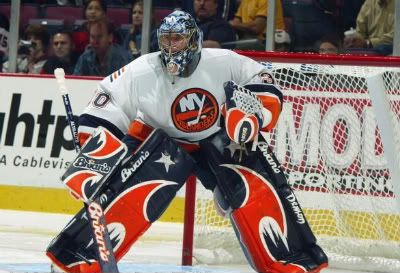
In an effort to increase scoring, limits were put on the size of goaltending equipment. I am not going to bother explaining how this works, because if you are unable to put this together, you should go back to daycare, and ask your teacher to explain to you again why the square peg just will not fit in the round hole. But in all honesty, it had gotten ridiculous. If you’re curious, here are images of Flyers/Islanders goaltender Garth Snow from the late 90s and early 2000s, and the DRASTIC contrast of Grant Fuhr from his days with the Gretzky-era Oilers dynasty. Keep in mind that the sizes of pucks and goals have not changed (and they never should…different argument for a later date). Clearly the equipment regulations were LONG overdue.
THE BAD:
The entire tie-breaking system currently in the NHL needs to simply disappear. To me, there is absolutely no redeeming quality. But to be fair, some of these changes came before the lockout and maybe don’t belong in this section, but due to their interrelatedness in the incestual gene pool of absolutely terrible hockey ideas, will be included.
First of all, what was so incredibly evil about ties that we needed to get rid of them? Too many games were apparently ending in ties, but keep in mind, this assessment was made before the positive changes of the section above were implemented. Ties used to result in one point being awarded to each team, while two points were given for a team that won, and none for a team that lost. That is simple, both mathematically, and logically. Overtime consisted of five extra minutes of hockey to decide a winner. If neither team scored, it was a tie. This is where the league went wrong. They wanted to increase the odds of a game ending with a winner. Sounds good to me, why don’t we SIMPLY EXTEND OVERTIME TO TEN MINUTES INSTEAD OF FIVE? Five extra minutes is not going to kill anybody. Instead, here is a sequential list of the changes that the league decided to implement:
(Beginning of time – 1998) Five minutes of extra hockey: if there is no goal, the game ends in a tie.
(1998) – Overtime is now 4 on 4. It is still five minutes, but the extra space on the ice is expected to create more scoring opportunities. Don’t get me wrong, I love 4 on 4 hockey, but only when it happens as the result of penalties. I don’t like the idea of a game being decided by anything other than more of the exact same, and the exact same is 5 on 5. But, given the circumstances (all-time low scoring numbers during the late 90s)…I can live with this.
(1999) – Teams are now awarded one point for an overtime loss, equating it to a tie. The thought was that with that guaranteed point, teams would play more aggressively and take more gambles in the hopes of gaining that second point. The idea of a losing team still receiving a point is absolutely mind boggling. “Participation awards” are for sports in which the participants’ ages are one digit (and even then…debatable). Not to mention, a team’s record is now reported in four numbers: wins-losses-ties-overtime losses. This is just too complicated, and now inflates the standings because of three point games. And did I mention it’s incredibly stupid?
(2005) – In the absolute worst decision the NHL has ever made, and this is NOT AN EXAGGERATION, I honestly feel that this is, bar none, the worst thing to ever happen to hockey, the shootout is introduced after 5 minutes of 4 on 4, thus eliminating ties. I understand that it is fun to watch, and I enjoy watching them, I truly do. I also understand that it is an attempt to draw new viewers to hockey, and convince old viewers who stopped following after the lockout to come back, but to me it represents everything I have already griped about. Shootouts, while fun, are not hockey. Hockey has these things called DEFENSEMEN. Defensemen make you work for your ice. The idea of deciding the winner of a game on a very isolated skill set is not just. Are breakaways a necessary skill for goalies and shooters alike? Absolutely, but it’s only one small element of hockey among many. Checking is also a PART of hockey. Why not decide games on the first team that can check someone through the glass? Or can we award a point for the team that makes the cleanest line changes? This is stupid, and now with ties eliminated, the win-loss standings are HORRIBLY inflated. In a league where >50% of the teams make the playoffs, there are still teams that miss the playoffs with a “winning record,” and teams missing the playoffs despite having earned more than half of their possible points. This is stupid.
(2011) – Scoring is significantly up from its decline in the 90s. So why are we still deciding games with a freaking donkey show? Moral of the story: Ties are not evil. There are 82 games in a season, (and no team has ever finished with more than 24 ties…and even that is insanely rare) a few of them can end in a tie. In my opinion, it makes playoff overtime that much more special. But if you want to minimize the amount of ties, why don’t we go back to 1997 and just double the length of overtime. Ten minutes and done.
The next atrocity of the “new” NHL is that stupid trapezoid. So, let me get this straight: In order to increase scoring, we are going to take away the goaltender’s ability to play the puck and make the first breakout pass? In order to increase scoring, we are going to ENCOURAGE teams to dump and chase? Wrong. A skilled goaltender that is able to play the puck dissuades teams from the dump and chase and opens up the game. Why, with the two line-pass eliminated, would you take away the goaltender’s ability to make that long pass? I don’t understand. To me, this is punishing a goaltender for having a skill, and the new NHL is all about skill. It’s counterintuitive and it doesn’t belong. Also, if we ever want to see a goaltender score a goal again, the trapezoid has to go.
Finally, the new Reebok Edge jerseys apparently suffer from “hybrid car syndrome.” Why does everything that represents new technology have to be an eyesore? Just as hybrid cars are absolutely obnoxious to look at, the Reebok edge jerseys make jean overalls look like they belong on the runway in Milan. Why did teams feel the need to make their sweaters so busy? Hockey sweaters were always simple in design, from the origins of the sport, and these new uniforms are just…hideous. Mercifully, several teams figured this out and either did not change their sweaters when Reebok purchased exclusive production rights in 2007, or have since realized how awful these things look and have reverted back to a more traditional look. I don’t doubt that the material is wonderful, lightweight, and moisture-wicking, so why do they have to look like the un-tucked dress shirt of a Jimmy Buffet fan that just vomited 46 years of Grateful Dead artwork onto his shirt?
THE IN-BETWEEN:
The absence of the two line pass is something I have mixed feelings about. Does it open the game up for skilled passers? Yes. Does it make it harder to trap and harder to sit on a lead? Absolutely. Does it add more odd-man breaks to the game? Yes. So what is my gripe? As miniscule as it is, there was something to be said for that defenseman with the skill to just graze the blue line, timing a barely legal pass to an equally skilled forward, barely grazing the other blue line. It was a very rare sight to see this executed perfectly, and I seriously doubt there is a highlight reel of this very phenomenon somewhere, but I will miss it. Brian Rafalski was among the best at this, and probably got little to no credit for this particular skill. So while I will never see another Rafalski-esque perfectly timed breakout pass, I can at least watch the long now-legal “homerun” pass, which as Tyler Seguin and Brad Marchand demonstrated in the very first goal of this young season, can be just as beautiful.
Barely noticeable is the fact that the rink is slightly smaller in the new NHL. Now, by slightly, I literally mean a couple of feet. Honestly, had I not read about this, I would probably not even have noticed, which makes me wonder why it was even done in the first place. It’s not a glaring problem, but seeing some of the new talent in the league, I don’t see why we can’t re-add those couple extra feet and see what someone like Sidney Crosby can do with just an extra 12 inches of space behind the net.
If you are still reading this, you need a life. Although I thank you for sticking with me, and I can promise that this will be among the longest (likely the longest) of anything I contribute. As a final word, I would like to remind anybody reading this that contrary to the volume of this article, there are far more goods than bads in the game of hockey, and if you don’t agree, you should probably get the hell off of this…as much as it pains me to say this word….blog.
That’s all I have to say for now, so until I feel the need to spew again, Cheers, Beers, Sake and Hockey.


No comments:
Post a Comment